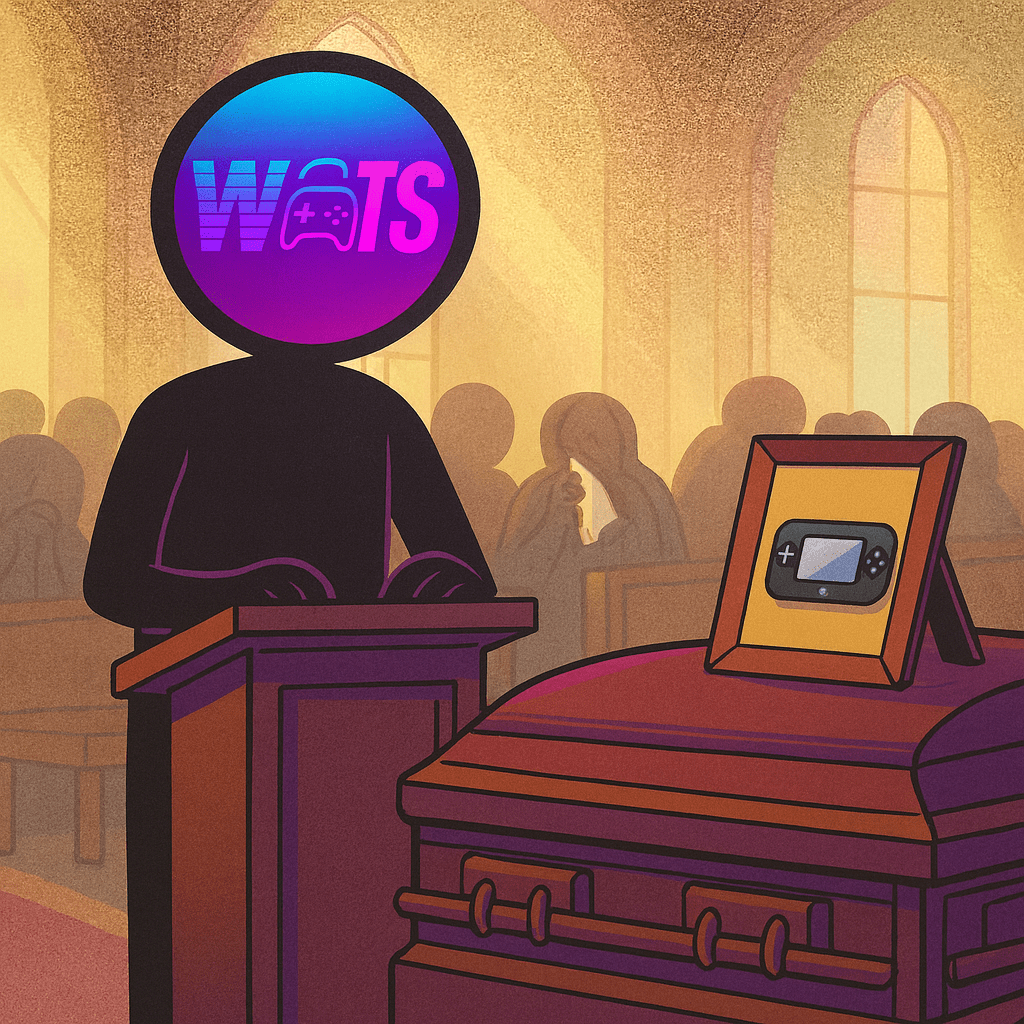
We are gathered here today to celebrate the life and legacy of our dear departed sibling, the Wii U. Ambitious, quirky, and tragically neglected, they fought through repeated challenges in their own home just to make a name for themselves.
While they may now rest in the dusty corners of our gaming cabinets, and their discs may remain unplayed in our libraries, we will remember them fondly — for what they were, and for what they weren’t.
Ashes to ashes, bruh-st to bruh-st.
An Identity Crisis in HD
The Wii U launched in 2012, wedged awkwardly between the runaway success of the Wii and the eventual global phenomenon of the Switch. And right from the start, it never really knew what it wanted to be.
Was it going to build on the Wii’s motion-controlled, party-game charm? Or was it leaning toward the GamePad innovations and gameplay-focused experiences we’d later see perfected on the Switch? The answer seemed to change depending on the day, and in the process, the Wii U never quite captured that clear “Nintendo soul” we’d grown accustomed to.
Looking back with hindsight, it’s not hard to see why the Wii U became the awkward stepchild of Nintendo’s console lineup — shoved into the same dusty attic as the Virtual Boy and Nintendo Labo.
Two Bricks and a Dream
The Wii U’s design was… ambitious. You had two main components: the main console (a sleek, rounded box with a disc drive) and the infamous GamePad — a large, bulky controller with an embedded touchscreen.
The GamePad was actually bigger than the console doing all the heavy lifting, with a battery that could barely last through a Mario Kart session. It required its own charging station, meaning you needed three outlets in play: one for the console, one for the GamePad, and one for the TV. Unless you had a power strip handy, setting it up felt like doing cable management for a small office.
And despite its size, you couldn’t actually leave the house with the GamePad. It wasn’t a portable console; it was a glorified second screen that mirrored gameplay from the main unit. Nintendo seemed to want the freedom of handheld play but couldn’t quite break the tether.
Death by a Thousand Cuts
No single issue doomed the Wii U — it was more like a thousand small, weird mistakes.
The triple-outlet requirement wasn’t a dealbreaker, but it was an early red flag for casual players who just wanted to plug and play. The lack of a clear identity made marketing a nightmare — even the name confused people, with many assuming it was just a Wii accessory. And while Nintendo had proven with the Wii that they could be the life of the party, the Wii U never managed to be more than the awkward guest standing in the corner.
The Prodigal Predecessor
But let’s not just remember the flaws — because without the Wii U, we might never have gotten the Switch.
Many of the Switch’s best features were built directly on Wii U experiments:
- A secondary screen experience (simplified into a self-contained portable).
- Improved battery life.
- Sharper, brighter displays for comfortable handheld play.
The Wii U stumbled so the Switch could sprint.
The Glory of Asymmetry
If there’s one area where the Wii U truly felt ahead of its time, it was in asymmetric gameplay — the idea that one player could have a completely different role or perspective than the others.
Two of its most memorable experiments:
- ZombiU – A survival-horror twist where the GamePad player controlled the placement and strength of zombies, turning them into a Dungeon Master for the apocalypse. It was rough around the edges, but it tapped into a design space that games like Dead by Daylight and Evolve would later take mainstream.
- Nintendo Land – A criminally underrated launch title and one of the best showcases for the GamePad. Whether you were a ghost hunting friends in Luigi’s Mansion, chasing candy-hoarding animals as bulldog guards, or playing keep-away in the Mario universe, it was proof that local multiplayer magic was still alive and well.
Reincarnation on the Switch
Some of the Wii U’s best and brightest didn’t die with the console — they were reborn on the Switch, where they finally found the audience they deserved:
- Mario Kart 8 → Mario Kart 8 Deluxe
- New Super Mario Bros. U → New Super Mario Bros. U Deluxe
- Donkey Kong Country: Tropical Freeze (with Funky Kong mode)
- Hyrule Warriors → Definitive Edition
- Super Smash Bros. for Wii U → Ultimate (spiritual successor)
- Bayonetta 1 & 2
- Captain Toad: Treasure Tracker
On the Wii U, these games were hidden gems. On the Switch, they became household names.
Closing the Casket
As we lower this oblong, boxy corpse into the bosom of Mother Earth, let us not mourn in bitterness. Instead, let’s celebrate the good it brought us.
Yes, the Wii U was flawed. Yes, it confused the public and tripped over its own design choices. But it was also daring, experimental, and home to some of Nintendo’s most creative ideas — ideas that would go on to shape one of the most successful consoles of all time.
Rest in peace, dear Wii U. May your ports sell millions, your GamePads stay forever charged, and your ghost forever haunt the halls of Nintendo HQ.
Amen.


 What’s On The Shelf | Games, Music & Culture
Leave a comment