The Gold Standard
Originally released as a Switch title in 2021, Monster Hunter Rise acts as the spiritual successor to the massively successful Monster Hunter: World. The version covered here is the 2023 PS5 port, which launched alongside the Sunbreak expansion — and even years later, it still slaps.
At this point, Capcom has cornered the market on “unbalanced hunting simulators.” Many have tried to steal their thunder — Prey, Wild Hearts, even Cabela’s Big Game Hunter (don’t laugh) — but nobody quite captures that strange magic the Monster Hunter franchise keeps bottling. Despite this being roughly the 25th entry, it still lands strong in the eager hands of players every few years. Consistent excellence can dull the senses, and Rise is another reminder of just how spoiled we are to keep getting games this good.
Hunt, Carve, Craft, Repeat
The premise hasn’t changed: hunt monsters, skin them alive, and wear their skulls as pants. It’s the most metal crafting loop in gaming.
You’ll post quests on the village board, gear up, and head out to whack a dinosaur with a hammer the size of a small car. Each hunt can last 20–40 minutes as monsters flee across zones, heal, or get reinforcements. You’ll chase, recover, and keep swinging until it finally keels over. Between rounds, you’re mashing together honey and herbs for healing potions like a medieval pharmacist on overtime.
The crafting system remains the heart of Monster Hunter. You’ll need to scavenge the world for herbs, mushrooms, ores, and monster bits to craft everything from potions and bombs to traps, steaks, and even “demondrugs.” (FDA approval pending.) You can buy most of this stuff from the Merchant in the hub — but where’s the fun in that?
New Tricks, Familiar Dance
Monster Hunter Rise builds upon World’s framework, tweaking just enough to feel fresh without reinventing the wheel. Your trusty Palicoes return — fuzzy feline companions who heal, buff, and occasionally bomb things — but they’re joined by a new best friend: the Palamute.
You can ride your Palamute to zoom across maps, shaving down travel time and adding a layer of mobility mid-battle. It’s a small but welcome change that makes exploration feel less like a slog. Both buddies can be equipped with weapons and armor themed after the monsters you’ve slain, but you’ll have to pick one companion per hunt. (Sorry, cat lovers — Trash Bag the Palamute earned my loyalty early on.)
Another addition is the Wirebug, a grappling-hook-style tool that lets you zip through the air or recover faster after getting knocked flat. It introduces a touch of verticality and flair to fights but doesn’t radically alter the formula. Rise remains a comfort food kind of game: familiar, flavorful, and satisfying in predictable ways.
The Rampage Mode
One of the few truly new features is Rampage Mode, a tower-defense-style diversion where you defend your hub from waves of monsters alongside the village NPCs. You can set up ballistae, cannons, and auto-turrets, or hop in and manually fire them yourself. It’s chaotic, messy fun — a great palate cleanser between long hunts — though not something you’ll likely revisit endlessly once the novelty fades.
Still, credit where it’s due: Rampage Mode shows Capcom experimenting within their own framework, trying to find new ways to keep the grind fresh. It’s not revolutionary, but it’s welcome.
Crush Your Enemies (and Make Pants Out of Them)
At the end of the day, the real reason to play Monster Hunter is right there in the title. The monsters.
There’s a ton of them, spanning returning icons and inventive newcomers. Rathalos and Rathian, the franchise’s fiery poster children, are back — joined by winged T-Rexes like Anjanath and electric flying squirrels like Tobi-Kadachi. Each creature has distinct movesets, weak points, and personalities. Some even fight each other mid-hunt, creating cinematic chaos that never gets old.
Each quest typically targets one specific monster, though side hunts often reward detours. If you need that Kulu-Ya-Ku beak to finish your new chestpiece, take a quick detour. Just be quick — every quest is timed, and nothing stings more than failing at 49:59 because a monster ran away to nap.
Slaying (or capturing) monsters earns you carves: claws, tails, hides, and assorted viscera used to forge weapons and armor. The best part? Every piece mirrors the monster it came from. Craft armor from Rathian and you’ll look like a medieval dragon slayer. Craft from Khezu and… well, you’ll look like a veiny, albino nightmare. Why would you do that to yourself?
The Joy of the Hunt
The weapon system remains one of gaming’s best. There are 14 weapon types, each so distinct that switching feels like learning a new class. You’ve got the rhythmic devastation of the Hammer, the elegant acrobatics of the Insect Glaive, and the artillery-grade chaos of the Heavy Bowgun.
Every weapon feels viable and satisfying when mastered — especially when coordinated with friends. A balanced team turns each hunt into something approaching jazz: every player riffing off each other, adjusting tempo and timing. My group usually ran heavy weapons (Hammer, Hunting Horn) while one friend used a Bow and another refused to commit to any one loadout — keeping things unpredictable but entertaining.
Even solo, your Palicoes and Palamutes can fill some tactical gaps with ranged or melee setups. Rise gives you the tools to play your way, whether that’s as a tanky brawler or a stylish aerial acrobat.
The Grind Never Ends — and That’s the Point
Hunting is only half the experience; the loop is the real addiction. You hunt to craft, craft to hunt bigger things, and before you know it, it’s 2 a.m. and you’re covered in digital scales. Rise understands that rhythm perfectly. The fights are long, brutal, and rewarding — battles that can stretch across volcanoes, forests, and subterranean caverns before culminating in that one perfect blow that sends a monster crashing to the ground.
That moment never gets old.
The Sunbreak expansion adds even more to chew on: new monsters, armor sets, and Master Rank hunts that’ll push even veterans to the limit. The difficulty spike is real, but so are the rewards — and the sense of mastery when you finally conquer a monster that’s flattened you a dozen times before.
Verdict — A Worthy Successor
Monster Hunter Rise doesn’t rewrite the rulebook, but it doesn’t need to. It’s faster, flashier, and more streamlined than World, but still unmistakably Monster Hunter.
The visuals pop on PS5, loading times are snappy, and the monster animations remain jaw-dropping. Sure, the repetition creeps in eventually, but that’s baked into the genre’s DNA. You’re not here for narrative twists — you’re here to whack a giant chicken until it explodes into craftable loot.
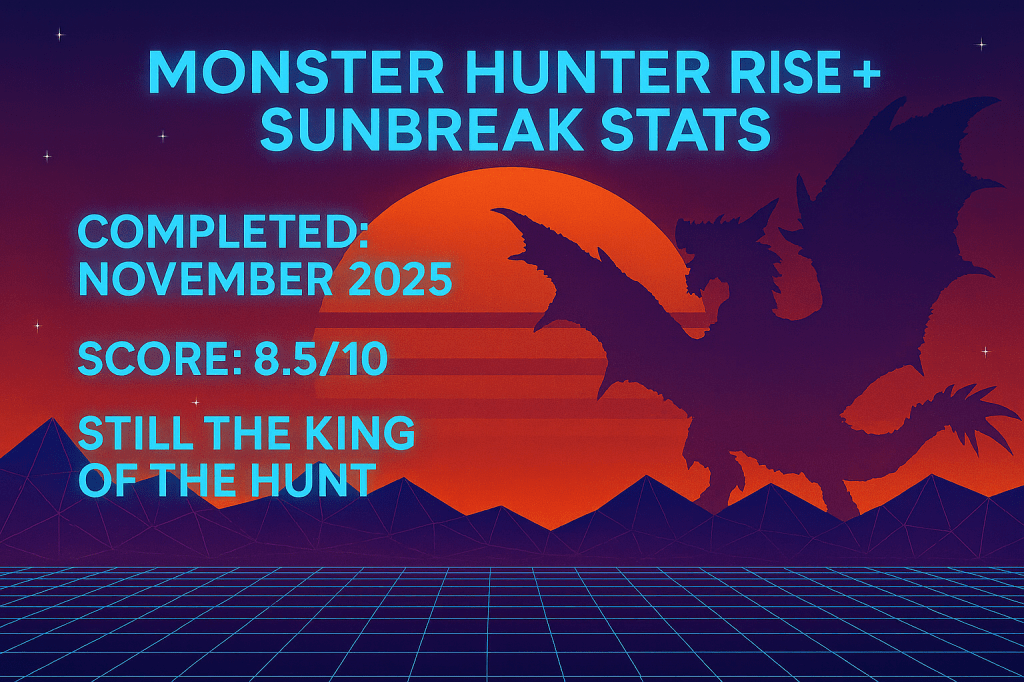
If you can snag the Rise + Sunbreak bundle at a good price, it’s absolutely worth your time. For veterans, it’s a refined side dish before Monster Hunter Wilds arrives. For newcomers, it’s a slightly gentler introduction to one of gaming’s deepest, weirdest, and most rewarding action loops.




 What’s On The Shelf | Games, Music & Culture
Leave a comment