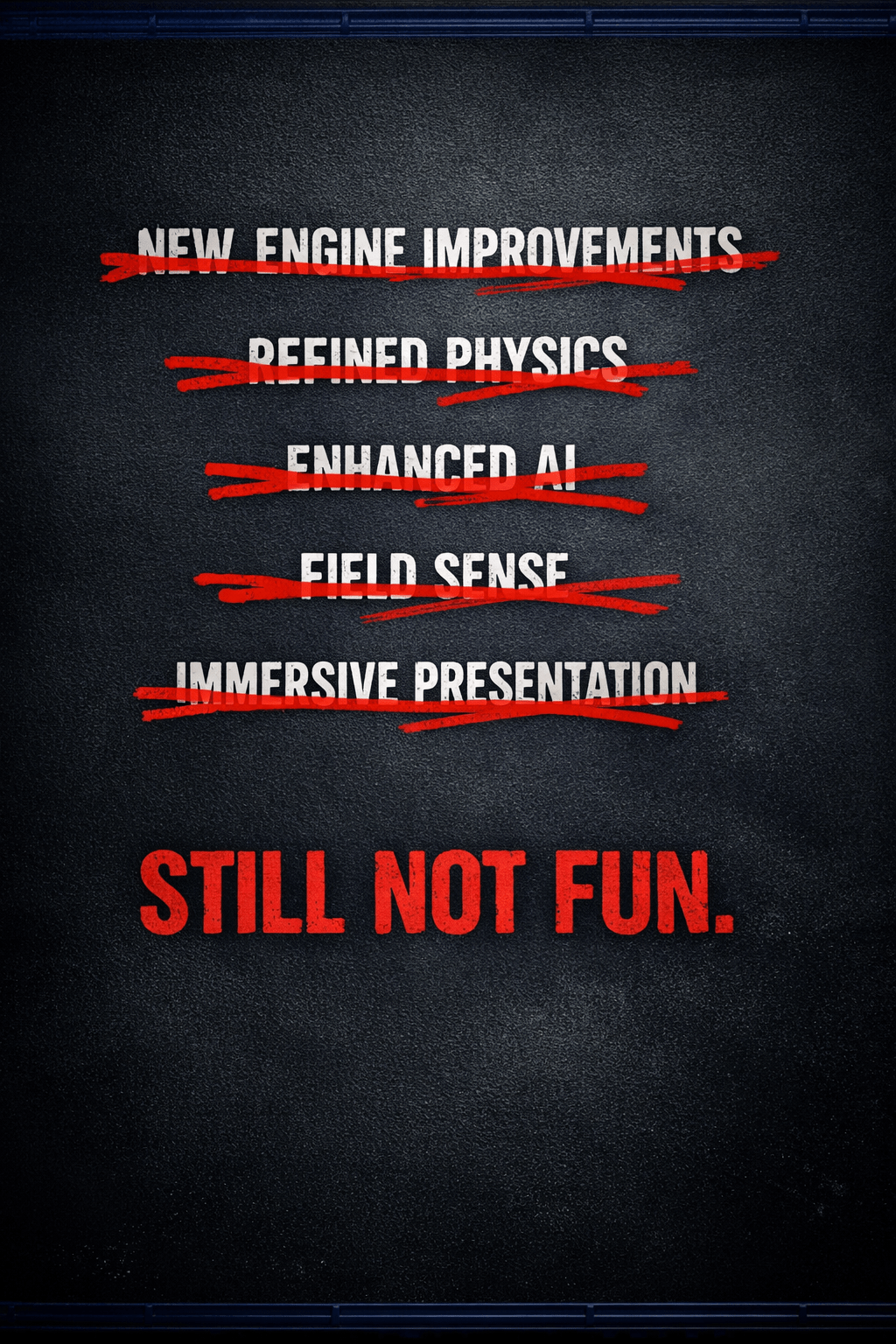
A love letter, an autopsy, and a plea
Sports games have always lived at the intersection of two massive cultural forces: the spectacle of live sports and the escapism of video games. For as long as there have been consoles plugged into CRTs or flat screens, there’s been some version of football, basketball, baseball, or boxing trying to translate real-world drama into pixels and polygons.
Sometimes that translation worked beautifully. Sometimes it worked too well.
Whether it was abusing the broken Bo Jackson in Tecmo Bowl or terrorizing defenses with Michael Vick in Madden NFL 2004, sports games didn’t just capture our attention—they captured our wallets. Year after year. Generation after generation.
For me, the overlap between “sports fan” and “video game sicko” is nearly a perfect circle on a Venn diagram. On the NES, it was Punch-Out!!. Then came wrestling—WWF, WCW, ladders, chairs, absolute nonsense. Then the Street games: football, basketball, pure chaos. Then Madden took over my life for a while. Eventually, I settled into NBA 2K and MLB The Show, where realism, simulation, and numbers mattered more than raw spectacle.
And somewhere along the way, something broke.
As my appetite for sports games shrank, I found myself drifting backward—returning to Punch-Out!!, NFL Street, NBA Street—while modern entries like NBA 2K21 or “Madden [Current Year]” sat untouched. The pendulum didn’t just swing back; it snapped.
Why?
And more importantly: what does that say about the state of sports games today?
I don’t think I’m alone in feeling this way. I also don’t think I’m some enlightened outlier shouting into the void. Sports games feel stagnant. Overproduced. Stripped of joy. Today, I want to look at where things went wrong—and whether there’s still a way to fix them.
Toss the Pigskin Around (Now With New Engine Buzzwords)
The biggest name in football gaming is Madden NFL. That’s true by branding, by licensing, and by sheer cultural inertia. Plenty of challengers have taken swings at the throne, but John Madden’s namesake franchise remains glued to it with industrial-strength adhesive.
There were cracks—most notably during the legendary ESPN NFL 2K5 era—but those days are long gone. Today, even the return of College Football doesn’t represent real competition, since it’s still under the EA umbrella.
Madden’s challengers have ranged from genuine threats to absolute fever dreams. You had serious contenders like 2K5. You had forgettable attempts like Maximum Football. You had glorious nonsense like NFL Blitz and Blood Bowl.
And then there’s me: someone who’s seen every Madden since 2004, owned roughly 80% of them, and perfected the gamer tradition of buying last year’s copy once it drops to the price of a firm handshake.
The problem isn’t that Madden is bad. The problem is that Madden stopped being interesting.
Ultimate Team dominates the marketing, the menus, and the monetization. Packs. Cards. Real money. A predatory loop that I want nothing to do with. I’m a Franchise guy. Always have been. Give me the fantasy of steering a team through decades—drafts, rebuilds, heartbreak, championships.
Here’s the uncomfortable truth: Madden has been built on the same bones since Madden 10.
Yes, there have been tweaks. Yes, there have been buzzwords. But the foundational experience hasn’t meaningfully changed in over a decade.
From Madden 05 to Madden 10, the series evolved.
The Hit Stick redefined defense. The Vision Cone made quarterback play tense and reactive. The Truck Stick and Highlight Stick elevated the run game. “Weapons” gave stars real identity.
Every year felt like a statement.
Then came the era of patch notes masquerading as innovation.
GameFlow.
Infinity Engine.
Refined Infinity Engine.
Frostbite Engine.
Improved Frostbite Engine.
X-Factors.
Momentum.
FieldSENSE.
Enhanced FieldSENSE.
This doesn’t sound like a video game franchise—it sounds like onboarding paperwork.
And when the NCAA Football series vanished for over a decade due to NIL issues, Madden lost the last thing that kept it honest: pressure.
If you wanted NFL football, this was it. No alternatives. No competition. No reason to prioritize fun.
Studios that did try something different—All-Pro Football 2K8, Backbreaker, Mutant Football League—either lacked polish, licensing, or staying power.
But here’s the thing: they tried.
Every couple of years, I replay Blitz: The League II, and it bums me out. Not because it’s bad—but because it’s fearless. Steroids. Broken bones. Moral bankruptcy. It was unshackled from the NFL’s sanitized image and allowed to be fun.
Madden didn’t lose because others failed. Madden lost because it stopped swinging.
Come On and Slam (Now in 4K)
Basketball tells a very different story.
While EA stumbled endlessly with NBA Live, 2K kept pushing forward. I jumped into the series around NBA 2K9 and never really left. In terms of time invested, it eclipsed Madden by a mile.
If Madden 07 is the high-water mark for football, NBA 2K11 is the crown jewel of basketball gaming.
The difference? 2K kept experimenting inside the simulation. Modes expanded. MyCareer became a genuine RPG. Franchise deepened. Presentation improved without smothering gameplay. Even when 2K stumbled, it never felt stagnant.
And then there’s the masterstroke: letting you start a franchise in any era. Want to rewrite history? Go nuts. That’s fun. That’s fantasy fulfillment. That’s understanding why people play games in the first place.
Sure, there are microtransactions. Sure, there are low points. But I’ll take a few missteps over a decade of creative paralysis.
The Seventh Inning Stretch
Baseball is weird.
It’s America’s pastime, yet its gaming history is oddly quiet. Today, MLB The Show stands alone—licensed, polished, competent.
My experience is limited: MLB 2000, MLB Slugfest, and MLB The Show 2024. They’re all… fine. Conquest mode is addictive. Card collecting scratches the itch. It’s a good baseball game.
But the GOAT?
Mario Superstar Baseball. No debate. No hesitation.
And Also the Rest!
Soccer? I know exactly one thing: Mario Strikers rules.
I owned Winning Eleven as a kid and learned nothing about soccer except that I didn’t care. Mario Strikers, though? Violence. Chaos. Personality. Fun.
Which brings us to the obvious conclusion: if you put Mario in it, it probably works.
Even Sonic Racing is having a minor renaissance. But for every good Sonic game, there are five good Mario ones. I’ll take the plumber.
So… How Do We Save Sports Games?
We’re stuck in a liminal space. The solution is simple, but uncomfortable:
Make them fun again.
Stop selling engine updates as features.
Stop introducing mechanics just to delete them next year.
Stop pretending yearly releases are mandatory.
If that means skipping a year? Do it. I’d rather wait than watch these franchises calcify into the unspoken horror of annualized Call of Duty releases.
Sports are dramatic. Messy. Emotional. Unpredictable.
Sports games should be too.
And until they remember that, I’ll be over here playing Punch-Out!!—again.


 What’s On The Shelf | Games, Music & Culture
Leave a comment