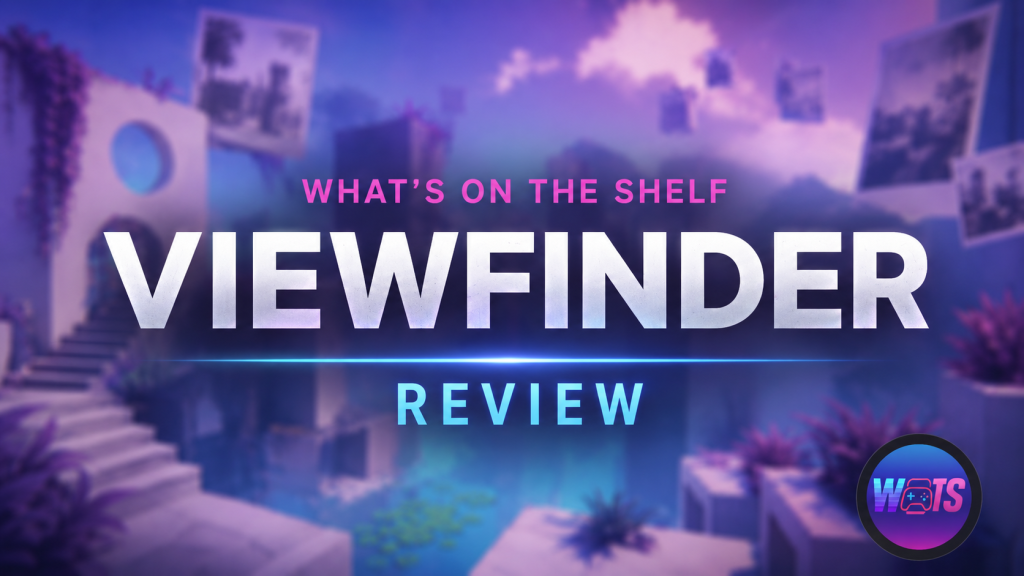
If you couldn’t tell by now, I am not really a puzzle game kind of guy. Despite this, they keep wandering back into my gaming queue, and honestly, I am pretty happy about that. Viewfinder continues that weird little roadway of success, setting up shop in the same general neighborhood as games like Cocoon, Animal Well, and Stray.
Admittedly, Viewfinder does not quite reach the same heights as those games, but there is still a lot of positivity to be found here. I’ll also be keeping this mostly spoiler-light where possible, because a good chunk of the experience is tied to seeing how the game bends your brain for the first time.
Originally released in 2023, Viewfinder was developed by Sad Owl Studios and published by Thunderful Publishing. If you want an exercise in the corporate greed of buying studios, growing too big, and then cutting real human jobs, feel free to take a tour around the Thunderful Group Wikipedia page. Anyway!
You awaken within a beautiful, oddly unsettling environment full of deep colors, open air, and history drip-fed through environmental storytelling. The whole place feels calm, empty, and quietly wrong in a way that works really well. Honestly, it reminds me a lot of the world of Neon White, minus the cringey anime shit and exploding firearms.
The actual gameplay is pretty minimal at first. You can move, jump, and wander around the environment. Your mission, should you choose to accept it, is to advance through each level, reach the teleporter, and move into the next zone. Simple enough.
Where Viewfinder really cuts its teeth is with its photography mechanic. The game lets you use photographs to create new landscapes, cross impossible gaps, open up the environment, and duplicate objects within the world. What appears to be a simple edge of a building floating in the air can be photographed, rotated, placed into the world, and transformed into a land bridge across a massive gap.
It is one of those mechanics that sounds like complete nonsense until you actually see it happen. Then, for a while, it feels like magic.
The game is split into several zones, each with its own dangers, rules, and challenges that build on the experience. Techniques that worked in previous areas may need to be completely thrown out in later environments. Viewfinder starts with simple pre-made photographs that the game hands to you, before eventually requiring you to take your own pictures and build out solutions yourself.
That progression is where the game is at its strongest. Viewfinder does a good job of keeping the experience fresh without resorting to excessive handholding for too long. It trusts the player enough to experiment, fail, and then stumble into the solution in a way that feels earned.
That being said, the bag of tricks starts to feel interesting but shallow near the end. By the time I reached the final area, I was dragging myself toward the finish line more than I was gleefully solving puzzles. Early on, there were plenty of those great “aha!” moments where the whole thing suddenly clicked. Later, it became more about ramming different ideas into the wall until something finally worked.
That freedom is part of the appeal, but it also creates a strange problem. Because Viewfinder gives the player so much flexibility, some puzzles feel less like they have an elegant solution and more like they are waiting for you to accidentally brute-force your way through them. It is a weird feeling, almost like the game is unfinished or slightly undercooked, even though the central idea is strong.
The closest comparisons are probably games like Portal or The Bridge, where the player is asked to bend the environment itself into a solution. Viewfinder has that same kind of reality-warping charm, and the Polaroid mechanic is genuinely something special. It is not the kind of puzzle hook you see every day, and the best moments of the game absolutely prove why the concept works.
The story is solid as well, though not quite as compelling as the mechanics. The initial mystery pulled me in, and the big early reveal gave the world some needed weight. After that, though, my interest in what was actually happening started to fade. The atmosphere remained strong, but the narrative did not quite keep pace with the novelty of the gameplay.
That is ultimately Viewfinder in a nutshell: really good, but not quite great. It has one of the coolest puzzle mechanics I have seen in a while, a beautiful world, and a strong sense of identity. It also runs out of steam before the finish line and never fully converts its brilliant idea into a truly essential experience.
It is probably the closest example of a game being a Top Shelf Game without actually crossing the threshold into those gilded halls. I would recommend Viewfinder to anyone with an interest in puzzle games, especially players who enjoy games that mess with space, perception, and logic. I just would not recommend it to absolutely everybody around me.
Cait can continue to be in any game she wants, though.
What a good kitty.






Leave a Reply