Millennials are now firmly in the mid-career stretch of our lives, roughly ages 30 to 45. On paper, we should be hitting our financial stride. In reality, we’re stuck in a strange in-between—making more money than we ever have while still feeling like the life our parents and grandparents built is just out of reach. That tension creates something weird in the brain. Big, traditional milestones like homes, long-term investments, stability, feel increasingly unattainable, and in their place we lean toward experiences, convenience, and small hits of joy. Sprinkle in a little FOMO and a steady, low-grade dread about the state of the world, and you’ve got a recipe for some truly questionable financial decisions.
At the same time, our generation is quietly rejecting the grind. The idea of working 60–80 hours a week just to maybe afford a house someday doesn’t land the way it used to. We want careers that work for us, not just the other way around. That shift is probably healthy. It’s also messy.
Because while we’re rethinking work, the world around us is louder than ever.
We live in an era of overwhelming access to information. News cycles don’t end, they spiral. Everything, everywhere, all at once, delivered straight to the glowing rectangle in our hands. Doomscrolling isn’t an accident; it’s a feature. Social media isn’t just addictive—it’s engineered to be. And it works. It’s incredibly easy to fall into that loop of comparison and despair. Everyone else seems to be doing better. Traveling more, buying more, living better lives while every headline screams that things are getting worse. That constant pressure, external and internal, wears you down and makes long-term planning feel pointless.
So instead, we cope.
Sometimes that coping looks like hitting “Buy Now.”
“Alright, get to the nerd shit already, pal.”
Fair enough.
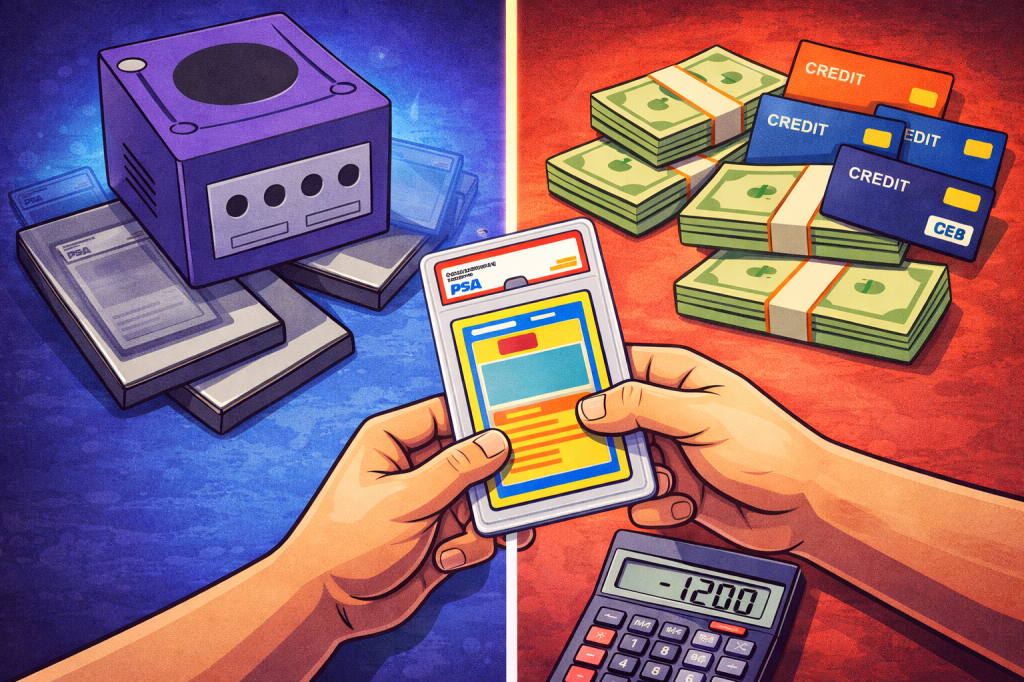
I recently went through the process of getting some of my old Pokémon cards graded through PSA. Before this, they were just sitting in a Trapper Keeper sleeve in my basement, relics of a childhood that felt both distant and strangely close. To my surprise (and mild horror) I discovered that some of these cards were worth several hundred dollars. I had unknowingly been sitting on a small treasure trove, and within hours I was pulling cards out, packaging them up, and shipping them off to be graded.
A few weeks later, they came back, neatly encased and assigned value. PSA even included offers to buy them outright. I kept one, the sentimental one, and the rest went up on eBay. Watching those numbers pop up on my phone as bids came in was… intoxicating. There’s no other word for it. For items that had been collecting dust, I was suddenly seeing real money, and it clicked, in a way that made me uncomfortable, that this is probably the same dopamine hit gamblers chase.
I was content selling them, but I couldn’t stop thinking about the other side of the transaction. Who is paying hundreds of dollars for a slightly misprinted Ninetales? Because someone is. Not just someone—multiple people. And not just for my cards. The higher-grade versions are going for thousands. This has created a bizarre, overheated market: vintage cards surging in value, newer sets immediately treated like speculative assets, and store shelves wiped clean not by kids but by adults chasing resale value. And if you’re one of those people clearing shelves before a kid can grab a single pack, fucking knock it off. Seriously. What’s wrong with you?
Of course, I’m not above falling into it either.
Because after selling those cards, I did what any rational Millennial would do: I went on eBay to buy back my childhood. I used to have a solid GameCube collection, and like a lot of us, I traded most of it in years ago for store credit, probably $15 here, $20 there, toward whatever the newest Call of Duty was at the time. Long-term value wasn’t exactly top of mind. Looking back, I lost some heavy hitters: Wind Waker, Luigi’s Mansion, Mario Sunshine, Star Fox Adventures, Def Jam: Fight for New York. I still had a few (Lost Kingdoms, thankfully) but the gaps started to itch.
Then I saw it. Def Jam: Fight for New York, sitting in a local game store, as beautiful as the day that I lost it, with a price tag of $120 slapped on it like a personal insult. I actually said out loud, “What in the fuck, how?” And the worst part? That wasn’t even overpriced. Online, $120 was borderline reasonable. Copies in good condition were pushing $200, and manuals alone were selling for $70. Look, I’m not a financial expert, but I know that $200 for a GameCube game is completely unhinged. For that price, it should come signed by Henry Rollins and personally insult me when I turn it on.
And yet… people are paying it.
This isn’t just a one-off. Luigi’s Mansion regularly hits $80–$120, and if you want the case and manual too, you’re suddenly negotiating like you’re buying a used car. It got me thinking: did this happen to previous generations? Was there a moment where our parents looked at something from their childhood and saw it explode in value like this, or did that kind of appreciation only exist in the realm of antiques, the stuff you’d see on Antiques Roadshow or Pawn Stars? Because those shows always focus on the seller, the person who finds grandpa’s old item and cashes out. We don’t really see the buyer, the person willingly dropping serious money on something purely because it reminds them of being ten years old.
But that’s exactly what’s happening now.
Nostalgia isn’t new, but Millennials might be uniquely positioned to be consumed by it. We’re old enough to feel it deeply and young enough to still chase it. More importantly, we’re at the income level where we can act on it, even if we probably shouldn’t. Physical media, especially, has become a nostalgia goldmine, and companies like Nintendo have built entire strategies around it. The NES Classic, the SNES Classic, endless re-releases and remasters—“remember this?” packaged and sold back to us. And yeah, I bought an SNES Mini. It’s sitting on my shelf right now, a tiny plastic monument to a simpler time that probably wasn’t actually simpler, just simpler in memory.
Because that’s the trick, isn’t it? We remember the feeling, not the reality. We remember being kids, not the chaos around us. We lived through things like 9/11 and watched it unfold live. But, somehow our brains still filed that era away as “better.” Memory is selective like that. Nostalgia fills in the gaps.
Meanwhile, the present feels harder to ignore.
Housing prices continue to climb at a rate that wages simply aren’t matching, and for many Millennials, homeownership isn’t just delayed—it’s borderline inaccessible. Rent becomes the default, not the stepping stone. And when the big goals feel out of reach, the smaller decisions start to shift. Why not take a shot on meme stocks? Why not throw some money into crypto? Why not finance that purchase with Afterpay, Affirm, or Pay in Four? It’s not always reckless, it’s often just easier, more manageable in the moment, with the problem pushed forward for future you to deal with.
But those decisions stack.
Every payment plan, every interest charge, every new line of credit, they all quietly move the goalposts further away. And layered on top of that is another shift: Millennials are having fewer children. For some, that’s a choice. For others, it’s financial reality. Raising kids is expensive in a way that’s hard to overstate, and when stability feels uncertain, hesitation makes sense. But that hesitation, combined with the spending patterns we fall into, creates a feedback loop.
We delay the big life decisions because we don’t feel financially secure, while at the same time making smaller financial decisions that make long-term security harder to reach. It’s not hypocrisy. It’s pressure.
And maybe that’s the core of it.
Millennials aren’t bad with money because we don’t understand it. We’re navigating a system that constantly pulls us in two directions: save for a future that feels increasingly abstract, or enjoy a present that feels increasingly unstable. So we bounce between the two. We sell our childhood for a quick win, then buy it back at double the price, and somewhere in between we tell ourselves that maybe, just maybe, we’ll hit on the next GameStop stock and it’ll all even out.





Leave a comment