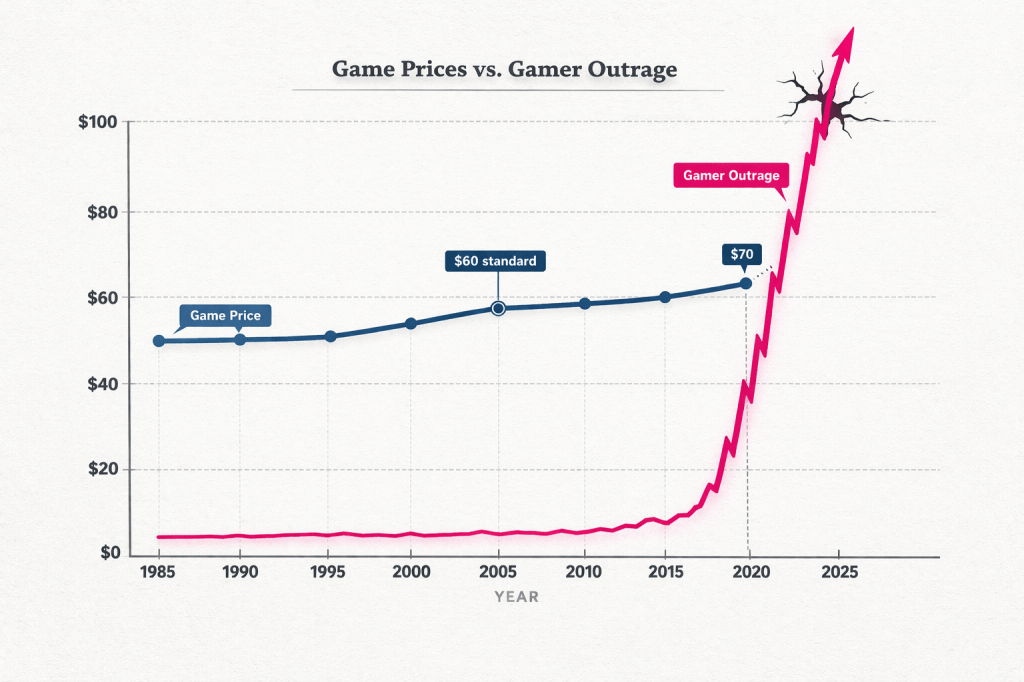
When did the video game market, industry, and consumers all get together and decide that $60 was the correct and only appropriate amount for a new title from a large studio? Recently, that price was nudged up to $70, and the blowback was immediate and loud. But is that what a game should cost? What even goes into the pricing of these things? And why am I asking you?
In the old days—when games came in chunky plastic cartridges and a plumber stomping an ape was socially acceptable—the video game industry was still figuring itself out. There were no real rules. Pricing wasn’t standardized. You could try to compare it to arcade games, but those were built on an entirely different model: quick hits for a quarter at a time. Home consoles didn’t have to follow those rules. They were selling an experience, not a loop designed to eat your spare change.
The history of console releases is a fun rabbit hole, partly because I don’t know half of these early machines. I came into gaming in the mid-90s. My world is more Mario Odyssey than Magnavox Odyssey. But those early consoles laid the foundation for everything we have now. Gaming moved into the home. You didn’t need an arcade anymore. For better—and definitely for worse.
The NES arrived in the mid-80s. Reagan was president, “Winners Don’t Use Drugs” was flashing across arcade screens, and gaming took its first real step into the modern era. The NES launched at $179. Games typically ran between $40 and $50, which sounds almost quaint today—until you remember the I-word: inflation.
That $179 console lands somewhere in the $500+ range today, and those $50 games creep well over $100 in modern dollars. Meanwhile, median household income sat around $17,000. If you were a kid lucky enough to get an NES, Punch-Out!!, and Super Mario Bros., you weren’t just getting a toy—you were getting a meaningful chunk of your family’s annual income. That bundle would translate to something like $800+ today. Suddenly, $70 doesn’t feel quite as offensive.
As cartridges faded and discs took over, costs shifted. Manufacturing got cheaper, storage expanded, and pricing started to stabilize. The original PlayStation launched at $299 in 1995—about $600 in today’s money. Games, meanwhile, settled closer to $50. Not cheap, but no longer swinging wildly like the cartridge era.
Then came the real turning point.
The Xbox 360 and PlayStation 3 era didn’t just usher in HD gaming—it quietly locked in the price of a video game. This is where $59.99 became the standard. Not $55. Not $65. Sixty.
The timing wasn’t random. Development costs were rising fast. Teams were getting bigger. Games were getting longer, more cinematic, more complex. Publishers needed a price increase from the $50 standard—but they also needed something consumers would accept. $60 became the compromise, and then it became the expectation.
The Xbox 360 launched at $299 (or $399 for the version most people actually bought), while the PS3 infamously hit shelves at $599—a number that felt outrageous then and still does now. Adjusted for inflation, that’s pushing $900. Sony pitched it as a premium device with Blu-ray capability. Most people just saw the price tag and walked away.
But here’s the interesting part: while console prices moved up and down with technology and strategy, game prices… didn’t.
From 2005 through the late 2010s, games stayed at $60. Through inflation. Through exploding development costs. Through an industry that ballooned into one of the largest entertainment sectors on the planet.
That stability wasn’t because games suddenly became cheaper to make. It was because the industry found other ways to make money.
DLC. Expansion passes. Microtransactions. Cosmetic shops. Battle passes. Live service hooks. The $60 price didn’t disappear—it just became the cost of entry. The rest of the bill showed up later.
At the same time, there were real cost-saving shifts behind the scenes. Digital distribution cut out retailers. Global markets expanded dramatically. Development pipelines became more efficient, even as teams grew larger. The industry got better at scaling revenue without touching the sticker price.
So were games ever really $60?
Not really. They were $60 to get in the door. After that, it depended on how much you wanted to engage.
Fast forward to today, and the shift to $70 feels like a breaking point—but it’s actually the first honest price increase in nearly two decades. And even then, when you compare it to income, games are arguably more affordable now than they’ve ever been.
That doesn’t mean every $70 game is worth it. Far from it. Some of the best games I’ve played in the last couple of years came in under $40. Some of the worst crept toward $100 once everything was added in. Looking at you, Civilization VII.
But the idea that $70 is some kind of unprecedented greed ignores the bigger picture. If anything, the $60 era was the anomaly—a long stretch where pricing stayed artificially low while everything around it got more expensive.
All this to say: the next time a game launches at $70 and the pitchforks come out, it might be worth remembering that we’ve been living in a pricing time capsule for almost 20 years.
The $70 game isn’t the problem. It’s just the first time the industry stopped pretending.





Leave a comment