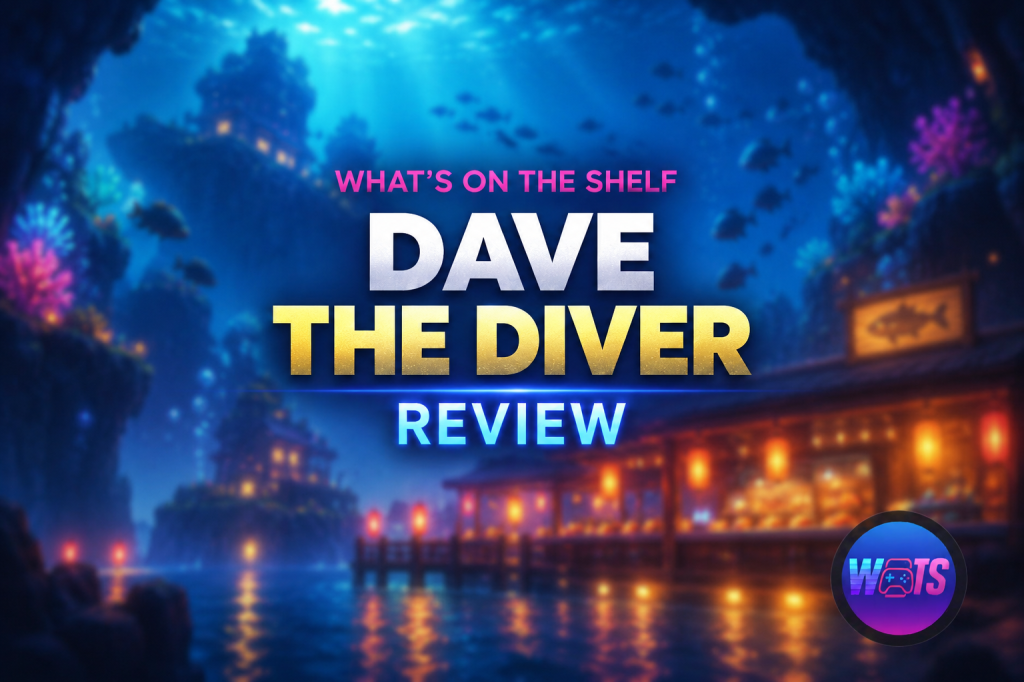
Is there such a thing as too much of a good thing?
In what feels like an instance where a game designer heard that question and responded, “You want too much? I’ll show you too much,” Dave the Diver attempts to cram as many genres, archetypes, mechanics, and visual styles as possible into a $20 package.
Most of those things are good. Some are great. There are simply so many of them that, by the end, you may need someone to roll you away from the table.
From the Sea to the Counter
Dave the Diver begins as a diving simulator where you play as the titular Dave, moving through the mysterious Blue Hole in search of fish. Why are you catching all these fish? Why, to eat them, of course.
Dave supplies a nearby sushi restaurant in what may be the shortest farm-to-table arrangement ever created. More of a sea-to-counter situation, I guess.
During the day, you dive for ingredients. At night, you work at Bancho Sushi as the manager, waiter, and general sweaty guy sprinting from one end of the restaurant to the other. Bancho rolls the rolls, while you deliver food and provide refreshments like green tea, beer, and cocktails.
Every dish has a price and a satisfaction score. The better the dish tastes, the happier the customer will be and the better the tip you’ll receive. You’re also responsible for deciding what goes on the menu, managing your available ingredients, and upgrading dishes by sacrificing portions of your fish stock.
Right away, Dave the Diver is two games stitched together. During the day, you manage oxygen, carry weight, depth, weapons, and whatever horrible sea creature has decided Dave looks delicious. At night, you manage inventory, menu prices, customer satisfaction, and the steady march of people demanding tea while Dave waddles frantically behind the counter.
The impressive part is that both halves work. The dangerous exploration gives you the ingredients needed to improve the restaurant, while the money earned at the restaurant allows you to upgrade Dave’s equipment and dive even deeper. It creates a satisfying loop in which each half continuously feeds the other.
Pun intended. Unfortunately.
Take Only Fish, Leave Only Harpoon Wounds
Each dive introduces new mechanics and new ways to approach the Blue Hole. You’ll quickly learn that how you catch a fish matters almost as much as what you catch.
Using a net or tranquilizer gun results in a higher-quality catch and provides more usable meat for Bancho Sushi. Harpooning a fish produces a lower-quality catch, while unloading a magazine into one generally leaves you with the seafood equivalent of hamburger meat.
That becomes important when upgrading dishes, because every upgrade consumes part of your available stock. Better catches mean more meat, more upgrades, better meals, and more money.
Early dives are mostly populated by smaller, nonthreatening ocean life. Eventually, larger predators begin appearing. Sharks, stingrays, lionfish, jellyfish, and other creatures are all waiting to take a chomp out of Dave.
That means you’ll eventually need something with a little more reach than a harpoon gun. Firearms even the playing field, allowing you to deal damage from a safe distance in exchange for a lower-quality catch. It’s a worthwhile trade when you’re planning a longer dive and would prefer not to spend the entire trip being dragged around by a shark.
Duff, a real weird, neckbeardy kind of guy, provides the tools you’ll need to defend yourself and any m’ladies you may encounter beneath the waves.
Oxygen Is Health and Health Is Oxygen
Dave doesn’t have a traditional health bar. Instead, one pool of oxygen functions as both your remaining dive time and the amount of damage you can take.
If you run out through poor planning—or poor positioning next to a shark—you’ll need to be rescued and returned to the boat. The catch is that you can only bring one item back from the expedition.
This creates a constant risk-versus-reward calculation. Do you return with everything you’ve collected, or push downward for just a few more meters? Maybe there’s an oxygen tank around the next corner. Maybe there’s a rare fish down there. Maybe a hammerhead shark is waiting to smack the confidence directly out of you.
The ocean does provide some relief through lootable chests scattered across the seafloor. These may contain oxygen tanks, weapon upgrades, harpoon improvements, or other useful tools. You can also discover rare cooking ingredients, unlocking new recipes or improving dishes you already serve.
It’s a wonderfully addictive system. Every dive feels productive, even if you don’t accomplish your original objective. You almost always return with new ingredients, upgrade materials, money, or at least a better understanding of which fish can completely ruin your afternoon.
Your head spinning yet?
Well, hold on.
Send in the Clown Car
A laughable clown car of additional mechanics and characters continually rolls up beside Dave’s boat before his morning dive.
Dr. Bacon expands the mythology of the Blue Hole and moves the main story forward. Ellie, a graduate student, provides collection quests that unlock new equipment and items. John Watson and the Sea Blue organization arrive every few days to fuck around, provoke Dave, and accuse him of destroying the local ecosystem.
Which, I mean, maybe.
Udo sends you into the depths to photograph unusual environments and marine life. Eventually, this expands into a questline centered on finding rare versions of normal fish. Then there’s Sato, who introduces a completely copyright-free version of a certain Pocket Monster game.
Gotta fish ’em all!
Those characters represent maybe 40 percent of the people Dave encounters. I’m avoiding details about the later story because some of its revelations come completely out of left field, but Dave the Diver never stops adding things.
The diving and restaurant mechanics remain the foundation, but you’ll eventually encounter farming, fishery management, Metal Gear Solid-style stealth, rhythm games, side-scrolling beat-’em-ups, a Tamagotchi-style virtual pet, restaurant-management expansions, and what is essentially Flappy Bird.
Every time you think you understand the full scope of the game, someone arrives on Dave’s boat and hands him another job.
Final Thoughts
At its core, Dave the Diver is a fun, low-stress diving and restaurant-management game. Unfortunately, it occasionally seems embarrassed by that simplicity.
The diving is satisfying. Managing Bancho Sushi is hectic without becoming overwhelming. The progression loop connecting the two is strong enough to carry the entire experience. The problem is that the game keeps interrupting that loop to introduce another character, system, minigame, or genre.
Most of those diversions are entertaining, and many aren’t required to complete the main story. It’s difficult to criticize a game for providing too much content, especially when so much of that content is polished and charming. Still, the constant expansion makes the experience feel unfocused. Just as you settle into a comfortable rhythm, Dave the Diver places another plate on the table.
It isn’t enough to make me dislike the game. It isn’t even enough to make me stop playing. It does, however, make me less interested in finishing it.
Dave the Diver is generous, charming, creative, and occasionally exhausting. I’ve enjoyed nearly everything it has served me. I simply don’t know if I need to eat all of it.
While I feel full and content, there’s just too much sushi on this plate.


 What’s On The Shelf | Games, Music & Culture
Leave a comment